Many rose growers spend heavily on premium fungicides and spray diligently every week, yet their bushes still drop leaves, develop bare canes, and suffer recurring outbreaks. Most spray failures are not caused by "weak" chemicals—they stem from three fundamental plant-pharmacology mistakes:
- Misunderstanding fungicide movement inside plant tissue: Contact sprays remain strictly on the waxy cuticle and cannot touch internal hyphae, while translaminar sprays cross the leaf blade but never travel down to the roots.
- Confusing True Fungi (Fungi) with Water Molds (Oomycetes): Spraying triazoles such as Anvil or Score (built for true fungi) against downy mildew (an Oomycete) produces zero control, allowing the outbreak to explode.
- Spraying the same single-site FRAC group more than twice in a row: Rapidly selects for resistant mutant strains that shrug off future treatments.

This guide breaks down the three fungicide movement pathways, the four molecular attack mechanisms, the biological divide between True Fungi and Oomycetes, physiological side effects on roses, and the FRAC rotation & synergy strategy.
1. Rose Leaf Anatomy and the 3 Fungicide Movement Pathways
To match each product to where the pathogen actually lives, visualize a rose leaf cross-section: the outer waxy cuticle, palisade mesophyll, spongy mesophyll with lower-surface stomata, and the internal vascular bundles (xylem and phloem).
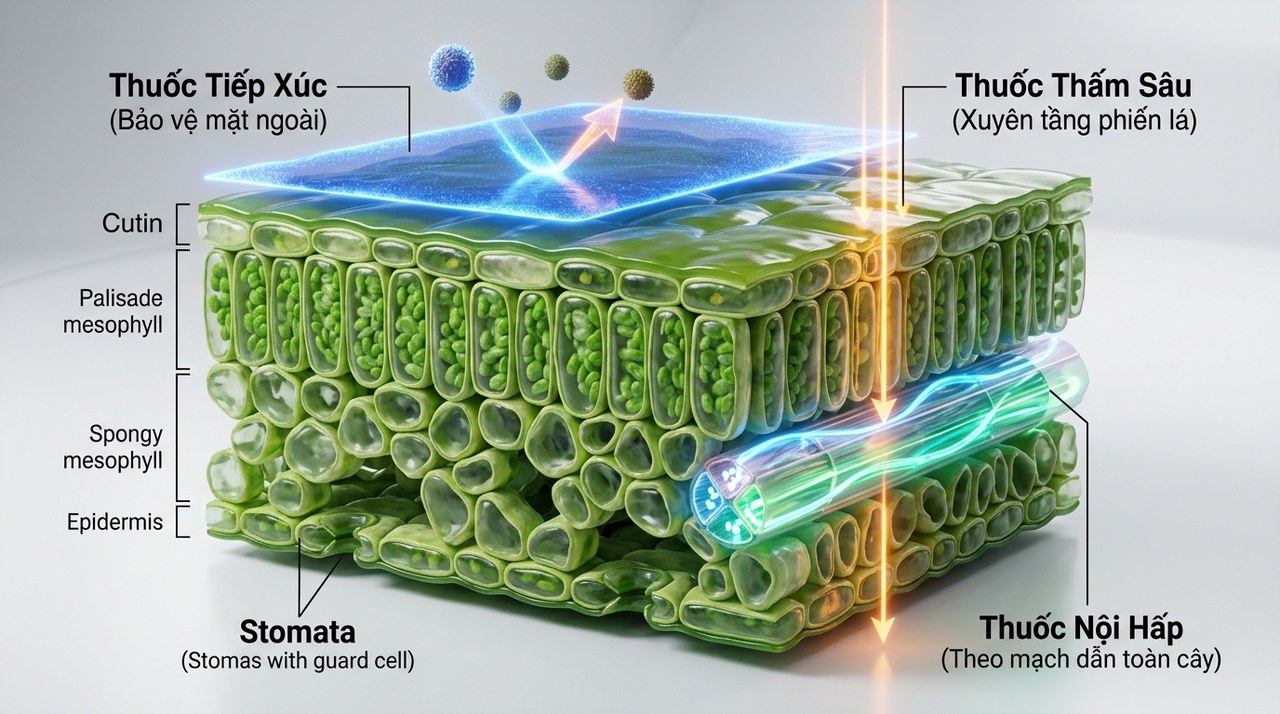
Based on how active ingredients navigate these layers, rose fungicides fall into three groups:
- Group 1 – Contact fungicides: Remain on the outer cuticle, forming a protective shield that stops spores from germinating.
- Group 2 – Translaminar fungicides: Penetrate straight through the leaf blade from the upper surface to the underside, eradicating hidden colonies underneath.
- Group 3 – Systemic fungicides: Enter the plant's vascular highway—moving upward via xylem into new shoots or bidirectionally via phloem all the way down to the collar and roots.
2. True Fungi (Fungi) vs. Water Molds (Oomycetes)
Understanding this cellular difference prevents the single costliest spraying mistake in rose care:
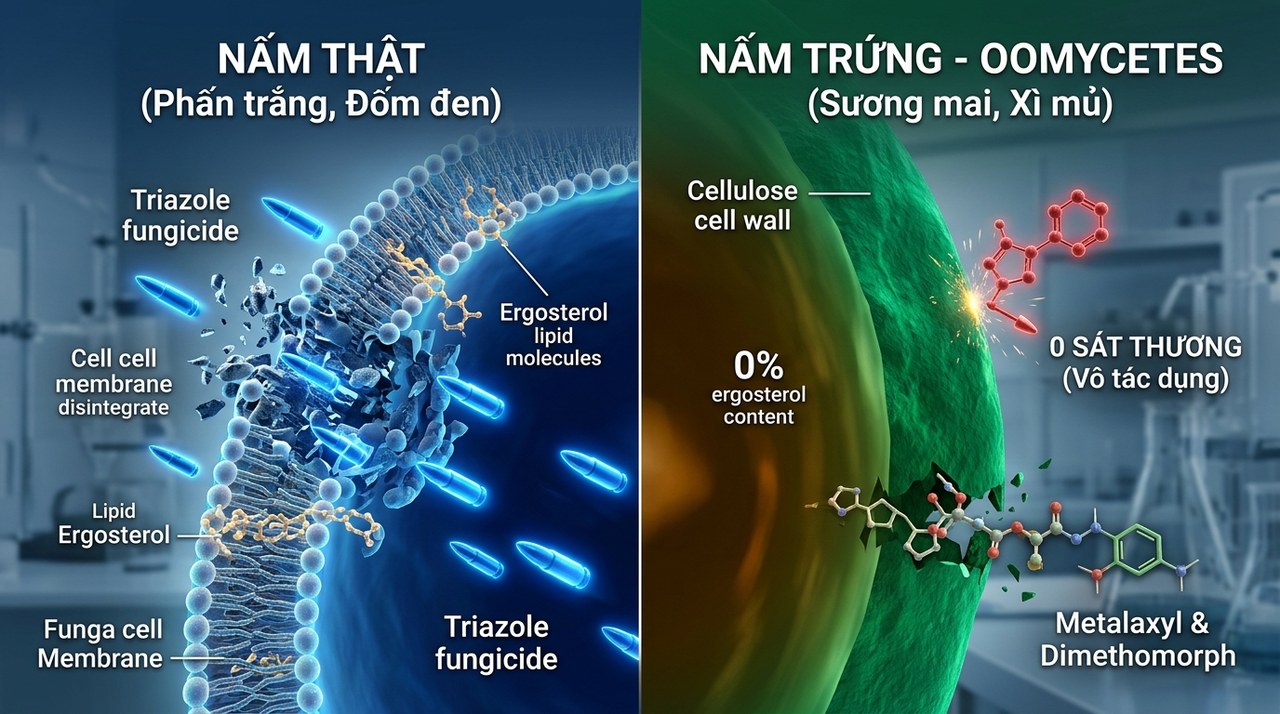
| Feature | True Fungi (Fungi) | Water Molds (Oomycetes) |
|---|---|---|
| Major rose diseases | Powdery mildew, black spot, anthracnose, rust, pink disease | Downy mildew (Peronospora sparsa), root rot, collar rot, stem gummosis (Phytophthora, Pythium) |
| Cell wall & membrane | Chitin cell wall; membrane contains Ergosterol | Cellulose cell wall; membrane contains 0% Ergosterol |
| Response to Triazoles (Anvil, Score) | Highly effective—disrupts Ergosterol synthesis and ruptures membranes | 0% activity (completely ineffective) due to absence of Ergosterol |
| Required active ingredients | Triazoles (FRAC 3), Strobilurins (FRAC 11), SDHIs, multi-site FRAC M | Metalaxyl-M (Ridomil Gold), Dimethomorph (Acrobat MZ), Fosetyl-Al / Phosphonates (Aliette, Agri-Fos) |
3. Molecular Science: 4 Lethal Strikes Against Fungal Cells
At the biochemical level, fungicides kill pathogens through four primary targets:
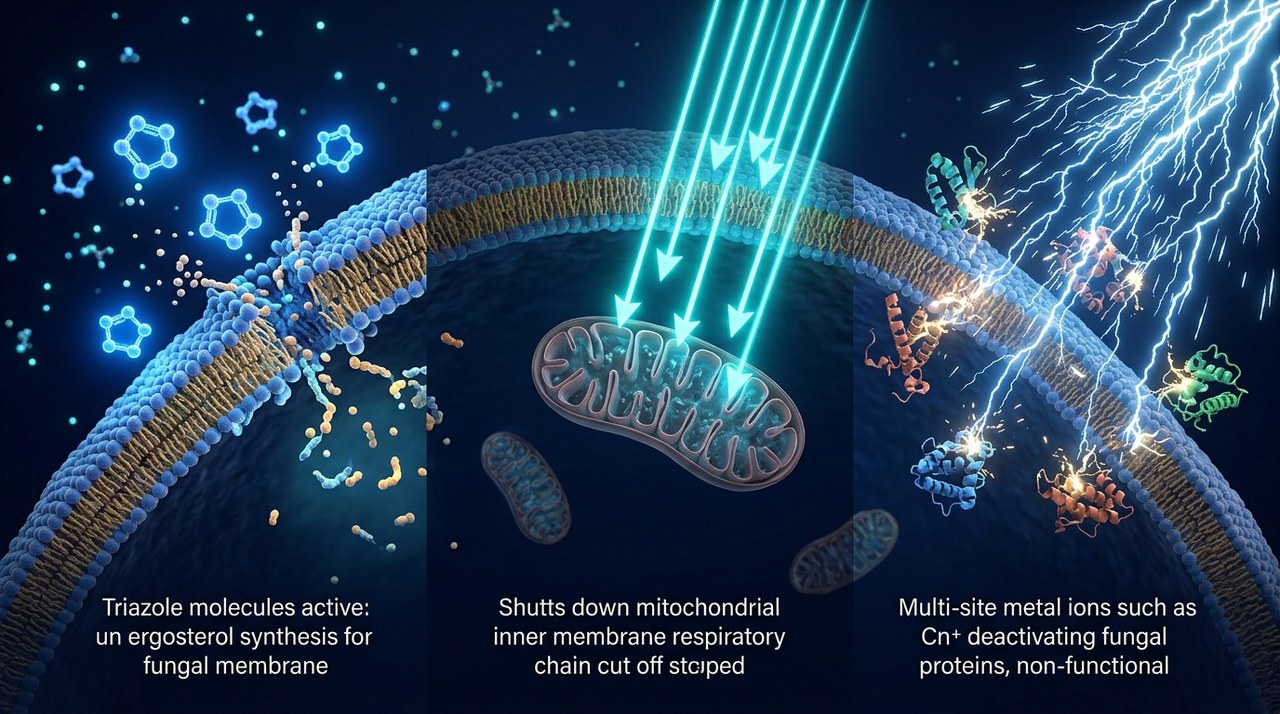
- Rupturing the cell membrane (Triazoles – FRAC 3): Locks down the CYP51 enzyme, halting Ergosterol synthesis. Without Ergosterol, fungal membranes perforate and leak cytoplasmic contents until the cell collapses (e.g., Anvil 5SC, Score 250EC).
- Shutting off mitochondrial ATP power (Strobilurins – FRAC 11 & SDHIs): Blocks the mitochondrial electron transport chain (or the Krebs cycle for SDHIs), cutting off ATP production so the fungus starves instantly.
- Multi-site carpet bombing (Copper , Zinc , Manganese – FRAC M): Unleashes metal ions and multi-site chemistries that simultaneously denature hundreds of vital fungal enzymes, making resistance mutations nearly impossible.
- Blocking the biological enzyme Trehalase (Validamycin): Halts glucose metabolism, starving hyphae so appressoria shrivel and fail to anchor into rose stems.
4. Group 1: Contact Fungicides (FRAC M)
External Cuticle Shield Mechanism
Contact fungicides coat the waxy cuticle evenly without entering leaf cells. When spores land and begin germinating, the multi-site barrier destroys their attachment structures and respiratory enzymes on contact.
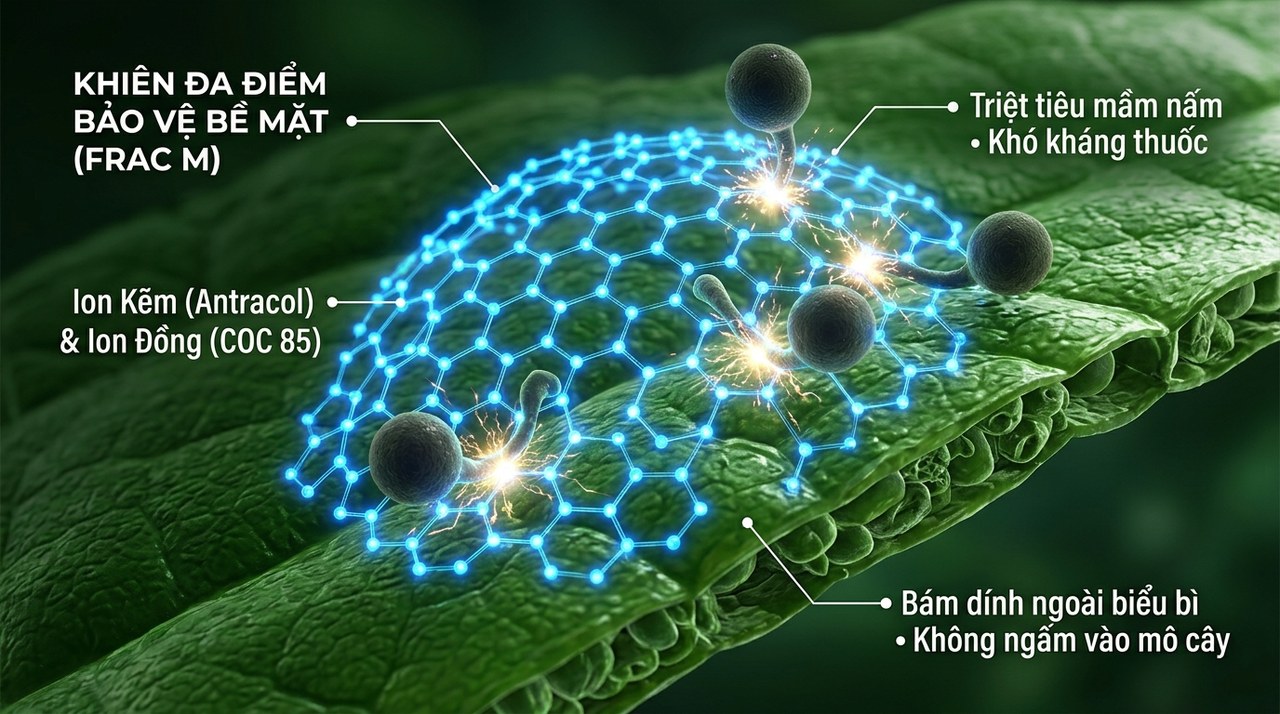
Two critical limitations:
- Easily washed off by rain unless paired with a sticker/spreader or applied well ahead of rainfall.
- No protection for newly emerging shoots and leaves that grow after spraying.
Best strategy: Spray preventively before rainstorms or humid cold fronts.
Five Classic Contact Products for Roses
- Antracol 70WP (Propineb): Supplies pure Zinc () for glossy green foliage and stronger post-rain photosynthesis. Ideal for black spot and anthracnose.
- COC 85WP / Champion 77WP (Copper): High-activity ions denature fungal proteins and scrub moss, rust, anthracnose, and cane fungi. Warning: Never spray under harsh midday sun.
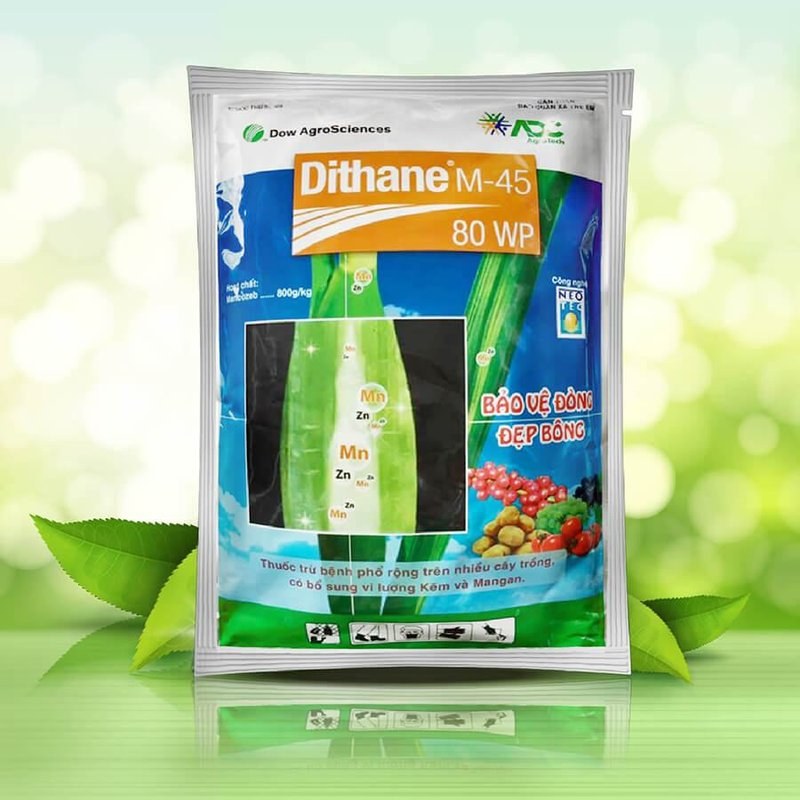
- Dithane M-45 80WP (Mancozeb): Delivers Manganese (Mn) & Zinc (Zn) to nourish the epidermis—a classic broad-spectrum rain-resistant armor against black spot and rust.
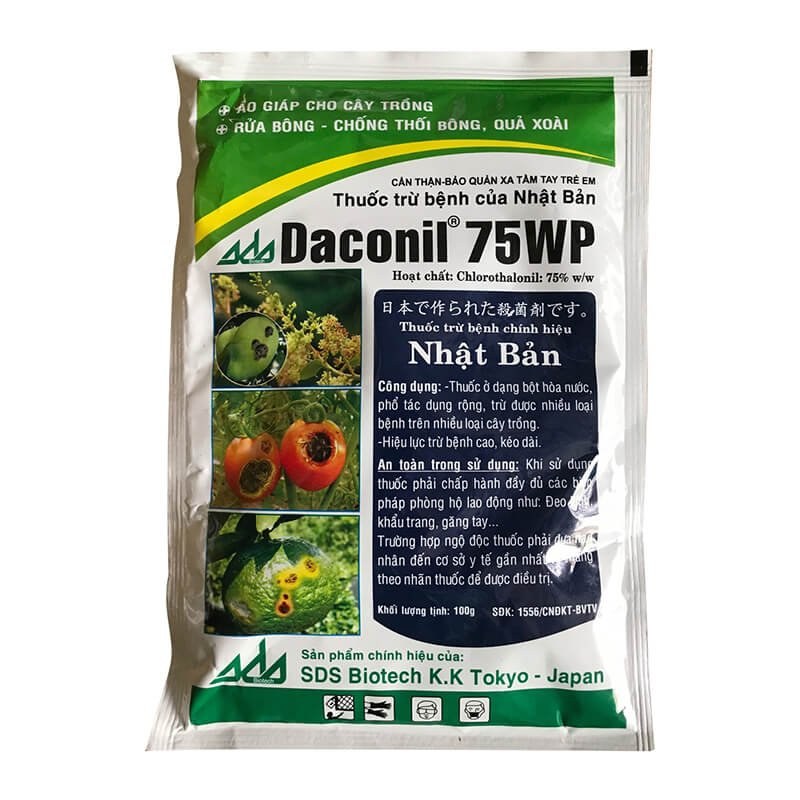
- Daconil 75WP (Chlorothalonil): Exceptional adhesion and rainfastness, maintaining a durable protective barrier against powdery mildew and leaf spots during persistent storms.
- Validamycin: A gentle biological antibiotic that blocks Trehalase, dries out pink-disease hyphae, stays completely cool on tender flower buds, and aids cane-crack healing.
5. Group 2: Translaminar Fungicides
Cross-Leaf Penetration and the "Green Effect"
When sprayed onto the upper leaf surface, translaminar actives diffuse straight through the epidermis and mesophyll to the underside—wiping out up to 80% of hidden powdery mildew colonies sheltered underneath the leaf.
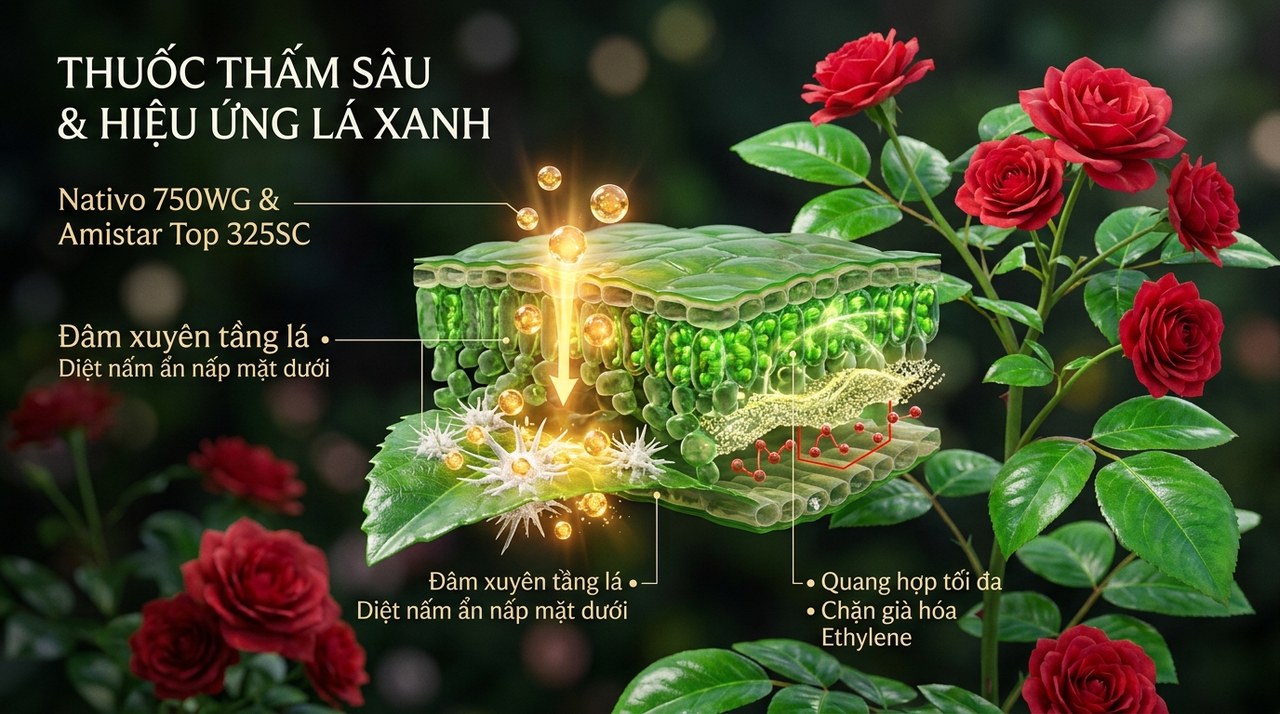
Beyond potent disease control, Strobilurin (FRAC 11) actives deliver two physiological bonuses:
- Green Effect: Activates Nitrate Reductase, boosting nitrogen assimilation and chlorophyll density for thick, glossy, heat-resilient foliage.
- Ethylene suppression: Slows senescence hormone production, helping rose blooms open with crisp petal form and stay fresh 3–5 days longer.
Two Premier Dual-Action Products (FRAC 11 + FRAC 3)
- Nativo 750WG (Trifloxystrobin + Tebuconazole): Dual strike combining mitochondrial ATP shutdown with Ergosterol membrane disruption. Absorbs rapidly within 1–2 hours (rainfast) to halt powdery mildew, anthracnose, rust, and black spot.
- Amistar Top 325SC (Azoxystrobin + Difenoconazole): Combines translaminar movement with systemic redistribution, delivering the strongest Green Effect for lush foliage and 3–5 days of extra bloom longevity.
6. Group 3: Systemic Fungicides
Xylem vs. Phloem Vascular Transport
Systemic actives enter the sap stream and travel along two distinct vascular routes:
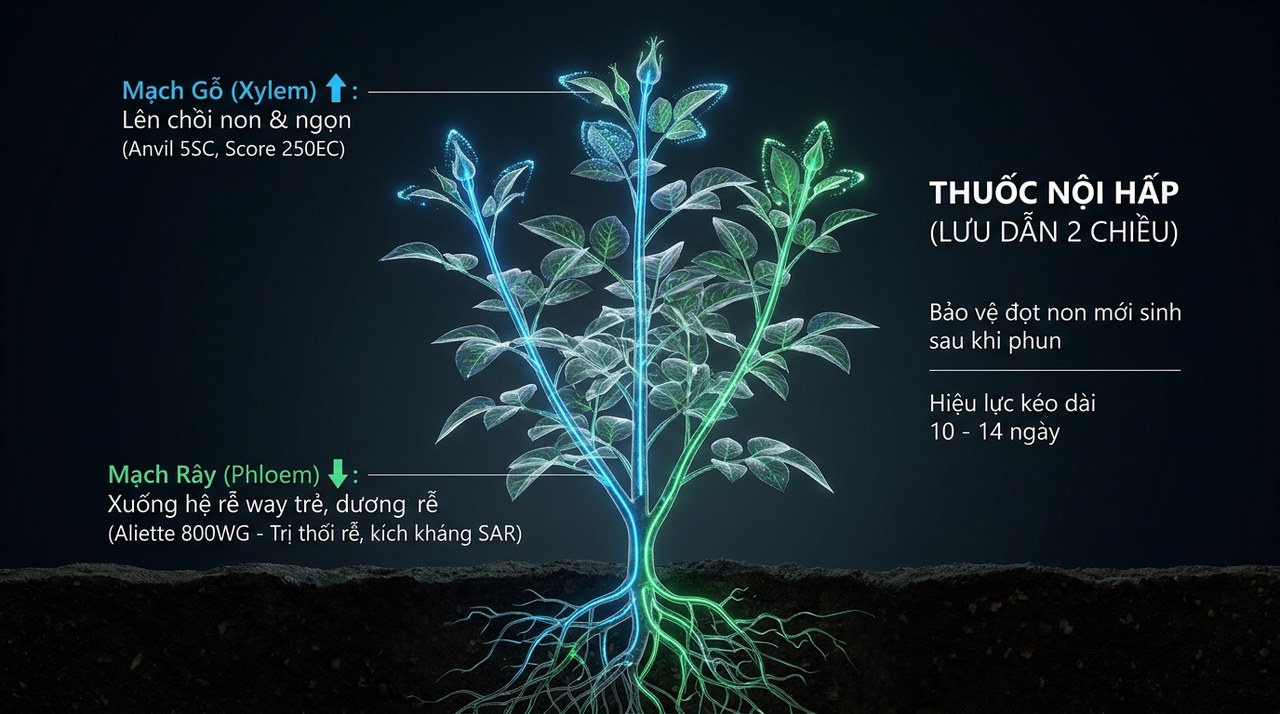
- Xylem (upward / acropetal): Moves upward into emerging shoots, young leaves, and flower buds, providing continuous protection for 10–14 days.
- Phloem (bidirectional): Foliar sprays travel downward into stems, root collars, and roots (and root drenches move upward). Essential for halting root rot, stem gummosis, and activating Systemic Acquired Resistance (SAR).
Three Specialized Systemic Subgroups
- Ergosterol & SDHI inhibitors (True Fungi):
- Anvil 5SC (Hexaconazole) and Score 250EC (Difenoconazole) block CYP51 to protect new shoots from powdery mildew, black spot, and pink disease.
- Viltop 20SC (SDHI) interrupts the Krebs cycle, excelling against cane-cracking pink disease.
- Bidirectional SAR activators:
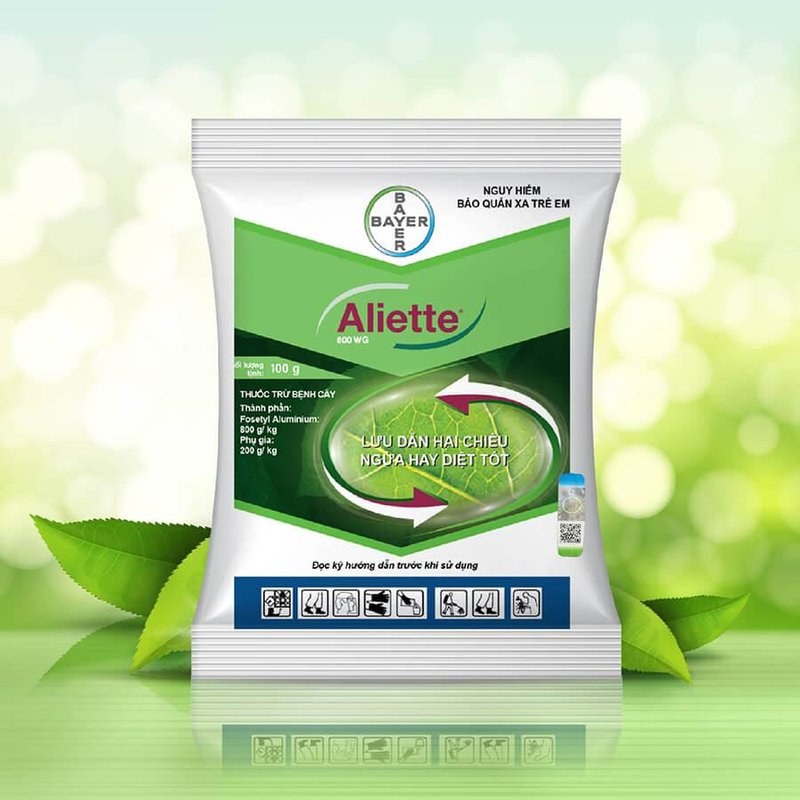
- Aliette 800WG (Fosetyl-Aluminium 800 g/kg) and Phosphonates (Agri-Fos 400) move both up and down the plant, triggering SAR defenses and cell-wall lignification to stop root rot, collar rot, and downy mildew.
- Oomycete specialists:
- Ridomil Gold 68WG (Metalaxyl-M + Mancozeb) halts Oomycete nuclear RNA synthesis while laying down an external Mancozeb barrier.
- Acrobat MZ (Dimethomorph + Mancozeb) directly disrupts the Cellulose cell wall of water molds.
- Mandatory rule: For downy mildew (Peronospora) or Phytophthora stem rot, always use Ridomil Gold, Acrobat MZ, or Aliette—never Anvil or Score.
7. Physiological Side Effects: Stunting & Burn vs. Green Effect
Knowing how fungicides interact with plant hormones protects both canopy health and bloom quality:
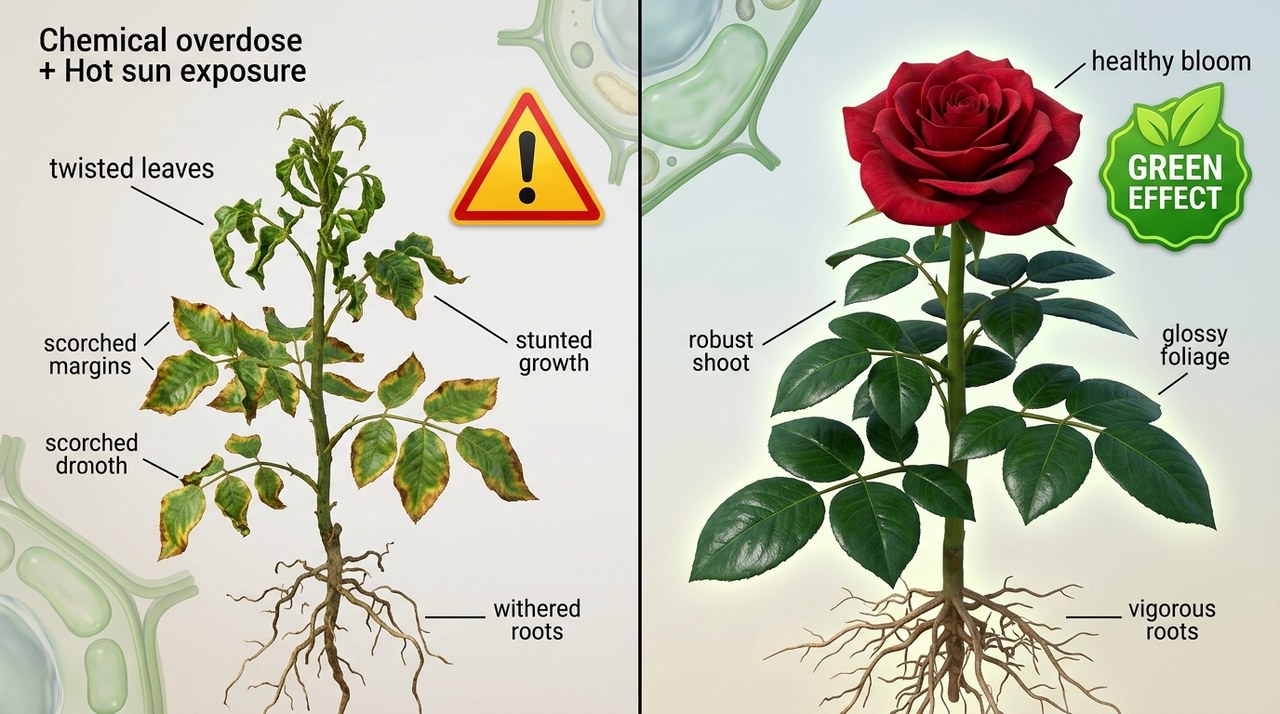
- Triazole stunting warning (Anvil, Score): Triazoles inhibit Gibberellin growth hormones. Correct dosing creates compact, sturdy shoots, but overdosing or back-to-back applications cause curled young leaves, stunted tips, and root setback.
- Never spray Copper under midday heat: Copper ions (COC 85WP, Champion 77WP) under strong sun trigger photothermal scorch on tender leaf margins and buds. Apply only in early morning or cool late afternoon.
- Leverage the Strobilurin Green Effect: Nativo 750WG and Amistar Top 325SC protect foliage while enhancing leaf thickness, gloss, and 3–5 days of extra vase/garden bloom life.
8. Quick Reference Matrix & 2 Golden Rules
Movement & FRAC Lookup Table
| Movement Group | Pathway in Plant | Key FRAC Codes | Commercial Examples | Primary Targets |
|---|---|---|---|---|
| 1. Contact | Outer waxy cuticle barrier | Multi-site M01, M03, M05 | Antracol 70WP, COC 85WP, Dithane M-45, Daconil 75WP, Validamycin | Preventive shield for black spot, anthracnose, rust, powdery mildew, pink disease |
| 2. Translaminar | Crosses leaf blade top-to-bottom | FRAC 11 + FRAC 3 | Nativo 750WG, Amistar Top 325SC | Underside powdery mildew, black spot, anthracnose, rust + Green Effect |
| 3. Systemic | Upward Xylem & 2-way Phloem | FRAC 3, FRAC 33 (P07) | Anvil 5SC, Score 250EC, Viltop 20SC, Aliette 800WG | True fungi (FRAC 3); root rot, dieback, downy mildew + SAR (FRAC 33) |
| 4. Oomycete Specialists | Systemic RNA / Cellulose wall + Contact | FRAC 4, FRAC 40 + M03 | Ridomil Gold 68WG, Acrobat MZ | Mandatory for downy mildew (Peronospora), collar rot, Phytophthora |
Two Golden Rules for Lifelong Rose Protection
- Strict FRAC rotation: Never apply the same single-site FRAC group more than 2 times consecutively (such as FRAC 3, FRAC 11, or FRAC 4). Rotate to a different mode of action on the next spray to block resistance.
- The "Inside-Out Synergy" Formula: Pair an external multi-site shield (Antracol 70WP or Mancozeb) with an internal translaminar/systemic strike (Nativo 750WG or Anvil 5SC for true fungi; Ridomil Gold 68WG for Oomycetes). This dual strategy wipes out incoming spores on the cuticle while eliminating established hyphae deep inside leaf tissue.