
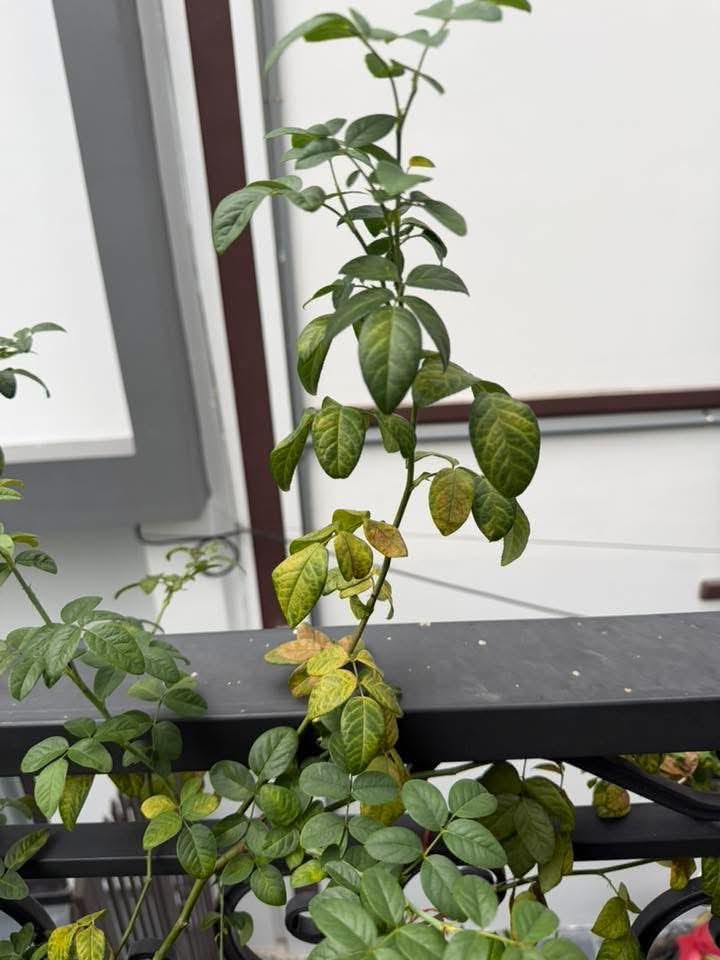
Root Waterlogging and Oxygen Deficiency in Roses: Causes, Symptoms, Differentiation, and Treatment Guide
1. What are Root Waterlogging and Root Oxygen Deficiency?
Plant roots not only absorb water and nutrients but also continuously respire to produce energy (ATP) for various physiological activities.
Under normal conditions:
- Soil or growing medium contains both water and air.
- Roots absorb oxygen from the spaces between soil particles.
- Oxygen is used to produce energy for water and mineral transport.
When the soil is waterlogged or retains moisture for too long:
- Air pockets are filled with water.
- Oxygen in the root zone is quickly depleted.
- Roots enter a state of oxygen deficiency (Hypoxia) or complete lack of oxygen (Anoxia).
As a result, the nutrient absorption capacity significantly decreases, even though the soil still contains sufficient nutrients.
2. Causes of Root Waterlogging
Prolonged Rain
This is the most common cause for roses.
After many days of continuous rain:
- The growing medium is always in a water-saturated state.
- Air cannot circulate down to the root zone.
- Roots suffocate.
Overwatering
Some rose growers have a habit of:
- Watering multiple times a day.
- Watering when the soil is still wet.
This keeps the root zone continuously in a state of oxygen deficiency.
Poorly Draining Growing Medium
Growing media that contain too much:
- Clay
- Untreated coir
- Uncomposted organic matter
can retain water for too long and increase the risk of root waterlogging.
Poorly Draining Pots
Drainage holes that are:
- Clogged
- Too small
- Covered by roots
can all cause water to accumulate in the pot.
3. What Happens to Roots When They Lack Oxygen?
Stage 1: Reduced Respiration
When oxygen decreases:
- Root cells cannot perform normal aerobic respiration.
- ATP rapidly decreases.
This reduces the ability to absorb:
- Nitrogen (N)
- Magnesium (Mg)
- Iron (Fe)
- Manganese (Mn)
- Potassium (K)
Stage 2: Damage to Young Roots
Feeder roots are the main nutrient-absorbing parts.
When oxygen is deficient:
- Feeder roots die first.
- White roots gradually decrease.
- Water absorption capacity significantly decreases.
Stage 3: Pathogenic Microorganism Growth
The anaerobic environment creates conditions for:
- Pythium
- Phytophthora
- Fusarium
to thrive.
At this point, the condition can transition from physiological waterlogging to actual root rot disease.
4. Symptoms of Root Waterlogging and Root Oxygen Deficiency
Yellowing Leaves from the Lower Canopy
This is often the first sign.
Cause:
When nutrients are deficient, the plant prioritizes resources for young leaves and new shoots, while recovering nutrients from older leaves below.
Leaf Veins Yellow or Pale First
Many people mistake this phenomenon for micronutrient deficiency.
Cause:
When nutrient transport capacity decreases:
- Cells around the vascular bundles become mineral deficient first.
- Chlorophyll decreases in the area around the veins.
- Veins or areas near the veins appear pale.
Mottled Yellow Leaves
Unlike typical nutrient deficiencies.
The yellow color is often:
- Asymmetrical.
- Without a clear pattern.
- Can appear on various leaves.
Slow Shoot Growth
Due to:
- Physiological water stress.
- Mineral deficiency.
The plant no longer has enough energy to maintain normal growth rate.
Premature Leaf Drop
This is a plant's self-protection mechanism to:
- Reduce transpiration.
- Reduce nutrient demand.
5. Why Do Leaves Yellow Even When the Soil is Very Wet?
This phenomenon is called:
Physiological Drought
Although the soil contains a lot of water, but:
- Roots cannot absorb it.
- The plant still lacks water.
This situation is similar to living in the middle of a lake but being unable to drink the water.
6. Distinguishing from Easily Confused Issues
6.1 Magnesium (Mg) Deficiency
Symptoms
- Appears on older leaves first.
- Leaf veins remain green.
- Leaf tissue between veins yellows.
Distinguishing Features
Mg deficiency creates an image of:
- A green vein network.
- A yellow leaf background.
Whereas root waterlogging often shows uneven yellowing with no clear pattern.
6.2 Iron (Fe) Deficiency
Symptoms
- Appears on young leaves first.
- Young leaves yellow.
- Leaf veins remain green.
Distinguishing Features
Fe deficiency almost always starts from new shoots.
Root waterlogging often appears first on older leaves below.
6.3 Root Nematodes
Symptoms
- Prolonged stunted growth.
- Fertilizing is ineffective.
- Shoots gradually become smaller.
Confirmation Sign
When checking roots:
- There are granular swellings.
This is a characteristic sign of nematodes.
6.4 Root Fungal Diseases
Symptoms
- Whole plant yellowing.
- Wilting in sunny weather.
- Slow growth.
Confirmation Sign
Upon inspecting the root system, you'll see:
- Black roots.
- Mushy roots.
- Root cortex peels off the core.
Unlike early-stage root waterlogging, the root system is truly destroyed.
7. How to Check the Root System
Gently remove the plant from its pot or check through the drainage holes.
Healthy Root System
- Many white roots.
- Creamy white root tips.
- No foul odor.
Oxygen-Deficient Root System
- Few new white roots.
- Roots turn yellowish or light brown.
- Not yet mushy.
Diseased Root System
- Black roots.
- Soft and mushy.
- Foul odor.
8. Treatment Approach
Step 1: Stop Watering
Only water when the growing medium starts to dry.
Do not water on a fixed schedule.
Step 2: Increase Root Zone Aeration
You can:
- Lightly loosen the surface of the pot.
- Create aeration holes.
- Move the plant to a sheltered location.
Step 3: Remove Severely Yellowed Leaves
Helps the plant:
- Reduce energy consumption.
- Focus on root recovery.
Step 4: Stimulate Root System Recovery
You can use:
- Humic acid
- Fulvic acid
- Seaweed extract
- Amino acids
at a light dose.
Avoid applying concentrated fertilizer during this stage.
Step 5: Prevent Opportunistic Fungi
If the soil has been wet for many days:
- Check the root system.
- Monitor for signs of root rot.
Only use fungicides when there are actual signs of disease.
9. Conclusion
Root waterlogging and oxygen deficiency are very common physiological disorders in roses, especially during the rainy season or when the growing medium drains poorly. The core cause is not a lack of fertilizer, but rather the root system losing its ability to absorb nutrients due to lack of oxygen.
Yellowing leaf symptoms due to root waterlogging are easily confused with Magnesium deficiency, Iron deficiency, nematodes, or root fungal diseases. Observing the location of symptoms, the pattern of yellowing, and especially the condition of the root system will help accurately identify the cause.
In most cases, improving root zone aeration and restoring the root system will be much more effective than continuously adding fertilizers or pesticides.