
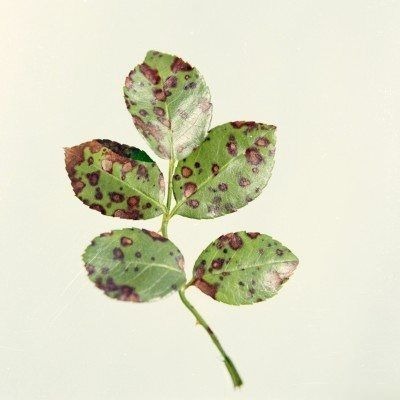
Differentiating Black Spot, Anthracnose, and Downy Mildew on Roses by Lesion Shape
Summary
Black spot, anthracnose, and downy mildew are the three most common fungal diseases on rose plants. They all produce spots on leaves, making them very easy to confuse, leading to incorrect diagnoses and ineffective pesticide use.
However, by understanding the biological mechanisms of each pathogen, growers can accurately identify them simply by observing the shape of the lesions. Black spot typically forms serrated edges with a yellow halo, anthracnose creates sharp, circular spots that can perforate the leaf, while downy mildew forms characteristic purple-brown lesions confined by the leaf vein system into polygonal shapes.
The article below will analyze in detail the causes behind the formation of each type of lesion and provide practical guidance on quick differentiation.
Overview of Three Common Rose Diseases
| Feature | Black Spot | Anthracnose | Downy Mildew |
|---|---|---|---|
| Causal Agent | Diplocarpon rosae | Sphaceloma rosarum or Colletotrichum spp. | Peronospora sparsa |
| Primary Development Location | Beneath the leaf epidermis | Throughout the entire leaf tissue | Intercellular spaces within the leaf |
| Lesion Shape | Circular, serrated edges, with yellow halo | Circular, concentric, gray center | Circular initially, polygonal in later stages |
| Impact on Leaf Veins | Not obstructed by leaf veins | Can destroy small leaf veins | Completely blocked by leaf veins |
Black Spot Disease: Why the Serrated Edges and Yellow Halo?
Black spot is one of the most common diseases on roses, especially in hot and humid weather conditions.
Cause of Serrated Edges
The fungus Diplocarpon rosae primarily develops just beneath the upper epidermis of the leaf. After spores germinate, fungal hyphae spread in all directions across the leaf surface without being obstructed by internal structures.
When observed with the naked eye, the tips of the spreading hyphae form small, fringed outlines resembling rootlets or serrated edges. This is the most characteristic sign of black spot disease.
Cause of the Yellow Halo
During its development, the fungus secretes substances that stimulate the aging process of leaf tissue. These substances break down chlorophyll around the lesion, causing the adjacent leaf area to turn yellow.
The yellow halo often appears before widespread leaf drop, thus serving as a warning sign that the plant is significantly infected.
Identification Signs
- Circular black spots.
- Small, fringed, serrated edges.
- Yellow halo surrounding the spot.
- Leaves yellow and drop prematurely.
Anthracnose: Why Concentric Rings and Leaf Perforations?
Anthracnose is a disease with strong leaf tissue destructive capabilities, thanks to its cell-degrading enzyme system.
Why Do Lesions Have Sharp Circular Shapes?
Upon invading the leaf, the fungus secretes enzymes such as cellulase and pectinase to break down plant cell walls.
These enzymes diffuse uniformly in all directions from the infection center, creating very distinct circular spots. Unlike downy mildew, anthracnose fungi can destroy even small leaf veins, so the lesions are not confined by the vein system.
Why Are There Concentric Rings?
Fungal development is strongly influenced by humidity and temperature.
- Humid nights: fungus develops vigorously.
- Dry days: fungus slows development and forms spores.
This repeated growth cycle creates concentric rings, similar to tree rings.
Why Do Leaves Perforate?
The center of the lesion is where leaf tissue is destroyed earliest. After cells completely die, this area becomes dry, brittle, and very fragile.
When exposed to wind, rain, or mechanical impact, the dead tissue falls out, leaving perforations on the leaf.
Identification Signs
- Sharp circular spots.
- Dry gray or white center.
- Concentric rings present.
- Leaves often perforate in the center of the lesion.
Downy Mildew: Why Circular Initially, Then Polygonal?
Downy mildew is a disease often confused with anthracnose or black spot when it first appears.
Early Stage: Circular or Oval Spots
After invading through stomata, the pathogen begins to spread in the intercellular spaces of the leaf.
In the early stage, the affected area has not yet reached the leaf vein system, so it retains a relatively circular or oval shape.
Late Stage: Formation of Polygonal Lesions
As the affected area grows larger, the fungal hyphae encounter the leaf vein system.
Leaf veins are composed of vascular bundles with thick, rigid cell walls. The downy mildew pathogen is unable to destroy this structure and is therefore completely blocked.
As a result, the lesions are confined by the leaf veins, forming very characteristic polygonal or angular shapes.
This is the most important sign for distinguishing downy mildew from other leaf spot diseases.
Identification Signs
- Lesions are purple, reddish-brown, or blackish-brown.
- Initially circular in shape.
- Later transforms into polygonal shapes.
- Edges closely follow the leaf vein system.
- Often appears in conditions of high humidity and cool temperatures.
Quick Practical Differentiation Tips
If you only have a few seconds to observe a diseased leaf, you can remember the following rules:
Black Spot
✓ Black spots have small, root-like fringed edges. ✓ Surrounded by a yellow halo.
Anthracnose
✓ Distinct circular spots. ✓ Dry gray or white center. ✓ May perforate the leaf.
Downy Mildew
✓ Purple-brown or reddish-brown lesions. ✓ Confined by leaf veins. ✓ Forms polygonal or angular shapes.
Conclusion
Although all cause spots on rose leaves, black spot, anthracnose, and downy mildew have entirely different pathogenic mechanisms. It is these differences in pathogen development that create their characteristic lesion morphologies.
Understanding the biological nature of each disease will help rose growers diagnose more accurately, choose more appropriate treatments, and act promptly before the disease spreads throughout the garden.
By simply remembering three core signs: serrated edges indicate black spot, a dry center with leaf perforation indicates anthracnose, and polygonal lesions confined by leaf veins indicate downy mildew, you can identify most common leaf diseases on roses.